

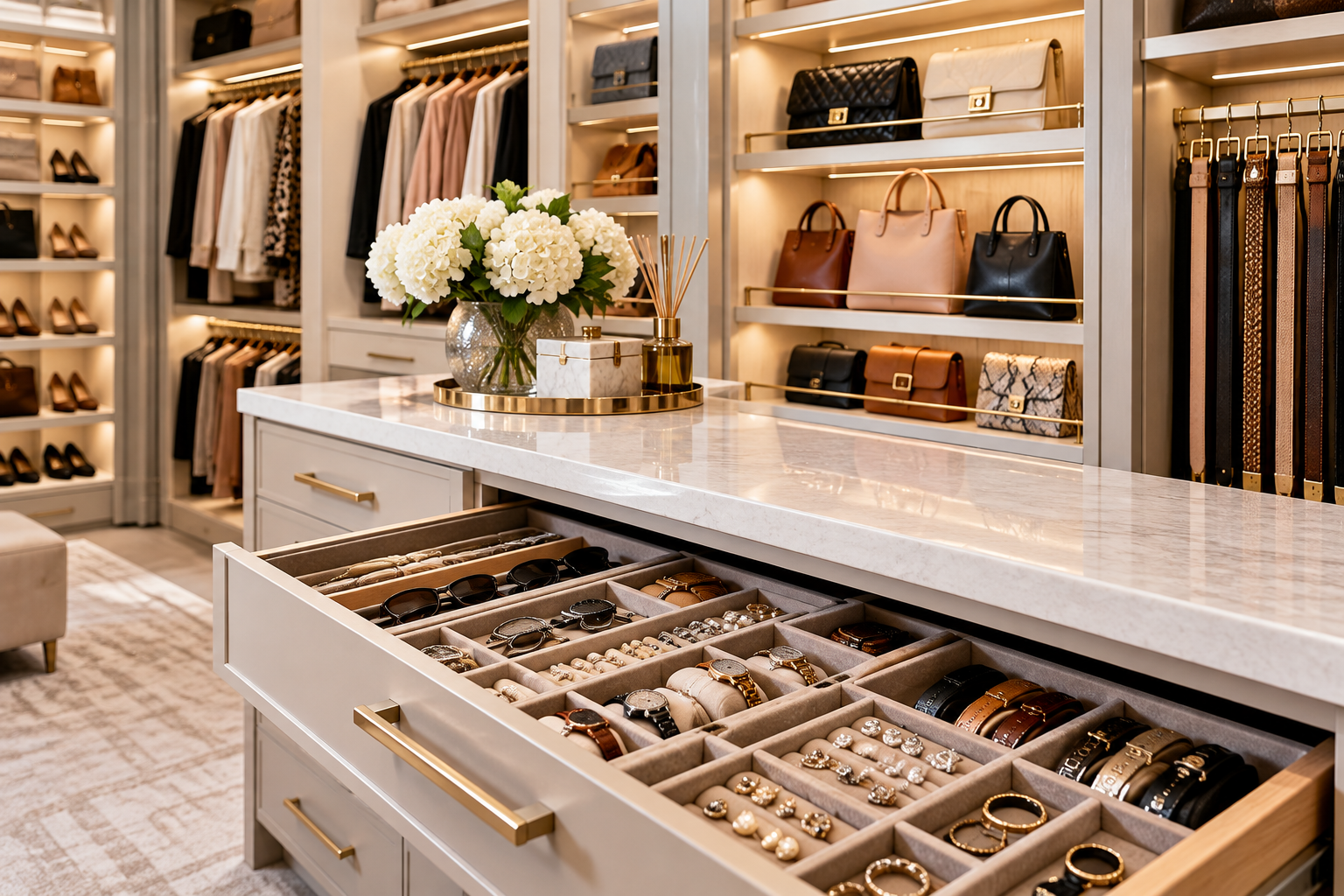
A well-organized closet should make it easy to find the accessories you need without searching through drawers, untangling necklaces, or moving bags from one shelf to another. Yet jewelry, handbags, belts, watches, and other small essentials are often among the hardest items to store neatly.
The solution is not necessarily a bigger closet. It is a storage system designed around the size, shape, frequency of use, and care requirements of each accessory.
Whether you have a spacious walk-in closet or a compact reach-in wardrobe, the right combination of drawer organizers, dedicated shelving, vertical storage, and accessible compartments can make your space more functional.
In this guide, we explore practical closet accessory storage ideas to help you organize jewelry, bags, belts, and everyday essentials while making better use of your available space.
Smart Ways to Organize Jewelry, Bags, and Belts ( Closet Accessory Storage İdeas )
1. Start by Grouping Accessories by Type
Before purchasing organizers or changing your closet layout, sort your accessories into categories.
Keeping similar items together makes it easier to determine which storage features you actually need.
Consider separating your accessories into these groups:
- Jewelry: Rings, earrings, necklaces, bracelets, and watches.
- Handbags: Everyday bags, work bags, clutches, and special-occasion purses.
- Belts: Casual, dress, leather, and seasonal belts.
- Small accessories: Sunglasses, scarves, wallets, and hair accessories.
- Occasional-use items: Special-occasion accessories, travel pieces, and seasonal items.
Next, identify which items you use every day and which you reach for only occasionally.
Frequently used accessories should be easy to access. Items used less often can be stored in secondary drawers, higher shelves, or protective containers.
This simple inventory provides a practical starting point for choosing the right storage solutions.
2. Use Divided Drawers for Jewelry
Jewelry can become tangled or damaged when different pieces are stored together without separation. A drawer with individual compartments helps keep items organized and easier to locate.
Consider incorporating a shallow jewelry drawer into a custom closet or dressing area.
Useful features include:
- Small compartments for rings and earrings
- Separate sections for bracelets and watches
- Longer compartments for necklaces
- Soft-lined inserts for delicate pieces
- Removable trays for flexible organization
Choose compartment sizes based on the jewelry you actually own. Tiny sections work well for rings and earrings, while necklaces and larger bracelets need more room.
For valuable pieces, consider a secure storage solution appropriate to their value and your household’s needs.
Design tip: Place frequently worn jewelry in the most accessible drawer, rather than storing everyday pieces at the back of a deep cabinet.
3. Prevent Necklaces From Tangling
Necklaces are particularly difficult to organize when several chains are placed in one container. They can knot together, and delicate chains may be damaged when pulled apart.
There are several ways to reduce this problem.
- Individual compartments: Store each necklace separately in a divided drawer or tray.
- Dedicated necklace hooks: Wall-mounted or cabinet-mounted hooks can keep chains separated and visible.
- Lidded jewelry trays: These provide a more enclosed option for protecting jewelry from dust when it is not being worn.
- Travel organizers: Small jewelry cases are useful for keeping selected pieces together when traveling.
When choosing a storage method, consider the necklace length, chain thickness, pendant size, and material.
For delicate or valuable jewelry, avoid overcrowding and follow the care instructions appropriate to the piece.
4. Create a Dedicated Handbag Storage Zone
Handbags vary considerably in size, shape, and structure. A small clutch requires a different storage arrangement from a large tote or a structured work bag.
A dedicated handbag section helps prevent bags from becoming stacked haphazardly or losing their shape.
Ideal Ideas for Bags
1.Use individual shelves for structured bags
Open shelves make it easier to see and retrieve handbags. Adjustable shelving is especially useful because it allows the space between shelves to accommodate different bag heights.
Avoid forcing oversized bags into narrow compartments.
2.Store smaller bags in cubbies
Clutches and compact purses can be grouped into individual cubbies. This approach separates bags while keeping them visible.
3.Keep frequently used bags within easy reach
Position everyday handbags at a comfortable height near the main dressing area. Special-occasion bags can occupy higher or less frequently accessed shelves.
4.Protect bags when necessary
Use suitable dust bags when recommended by the manufacturer. Store structured bags in a way that helps them retain their shape, and avoid placing heavy items on top of them.
A well-planned handbag section should provide enough room to retrieve each bag without rearranging the entire shelf.
5. Choose the Right Storage for Belts
Belts can take up surprisingly little space when stored properly, but they quickly become difficult to manage when mixed with other accessories.
Three storage options work particularly well.
- Pull-out belt racks: These provide a dedicated location inside a closet cabinet and allow belts to be accessed without removing other items.
- Drawer compartments: A divided drawer can accommodate rolled belts, provided the compartments are sized appropriately.
- Individual hooks: Hooks can work in a compact closet where drawer space is limited.
The best choice depends on the number of belts you own and how you prefer to access them.
Avoid storing belts in a way that creates unnecessary pressure on the material or causes them to become misshapen. Follow the manufacturer’s care recommendations for leather and other specialty materials.
6. Organize Watches, Sunglasses, and Small Essentials
Small accessories often disappear into the corners of drawers because they do not have a clearly assigned storage location.
Dedicated compartments make these items easier to locate and return after use.
Consider the following arrangements:
- Watches: Use appropriately sized watch compartments or padded trays.
- Sunglasses: Store pairs in individual cases or divided sections to protect lenses.
- Wallets and cardholders: Assign a small drawer section for everyday essentials.
- Hair accessories: Use shallow compartments to separate clips, ties, and headbands.
- Scarves: Use a dedicated drawer, shelf, or hanging organizer suited to the fabric and storage space.
For watches and other valuable items, choose storage that suits their materials and care requirements.
The goal is to create a specific home for each category instead of allowing small items to accumulate in a general-purpose drawer.
7. Make Better Use of Vertical Closet Space
When a closet feels crowded, the problem may be how the available space is divided rather than the total amount of space.
Vertical storage can help organize accessories without using additional floor area.
Useful options include:
- Adjustable shelves for handbags
- Narrow vertical compartments for clutches
- Wall-mounted hooks for selected accessories
- Pull-out racks for belts and similar items
- Upper shelves for occasional-use accessories
The important consideration is accessibility. Frequently used items should remain within comfortable reach, while less frequently used belongings can occupy higher storage areas.
Before adding shelves or racks, check that they will not interfere with doors, drawers, hanging clothes, or other closet components.
For more detailed guidance on using available depth and storage features, explore our guide to custom closet system depth.
8. Consider a Closet Island With Accessory Drawers
A closet island can provide a central location for organizing accessories in a sufficiently large walk-in closet. Depending on the design, it may incorporate shallow drawers, divided trays, additional shelving, or a countertop for arranging outfits.
Accessory drawers are especially useful for jewelry, watches, belts, and other small items that benefit from separation. However, a closet island is not suitable for every space. The design needs to preserve comfortable walking clearance and allow closet doors and drawers to open without obstruction.
In a smaller walk-in closet, well-designed perimeter storage may be a better use of the available area. Explore our walk-in closet island ideas to see how additional storage can be integrated into a larger closet layout.
9. Use Lighting to Improve Visibility
Even an organized closet can be frustrating when accessories are difficult to see.
Jewelry compartments, handbag shelves, and darker cabinet interiors may benefit from carefully planned lighting.
Consider these options:
- General lighting that illuminates the entire closet
- Task lighting near a dressing surface or vanity
- Integrated lighting that helps illuminate shelves and compartments
Lighting placement should minimize shadows and make it easy to distinguish colors and locate individual items.
If you are planning a new closet or remodeling an existing one, consider lighting during the design stage rather than treating it as an afterthought.
Our closet lighting ideas guide can help you explore ways to improve visibility.
10. Choose Open or Closed Storage Based on Your Needs
Open shelves and closed drawers offer different benefits for accessory organization.
| Storage type | Best suited for | Main consideration |
|---|---|---|
| Open shelves | Handbags and frequently used items | Items remain visible but collect dust more easily |
| Divided drawers | Jewelry and small accessories | Contents stay separated and less exposed |
| Pull-out racks | Belts and selected accessories | Easy access within a cabinet |
| Cubbies | Clutches and smaller bags | Individual items have defined spaces |
| Lidded organizers | Occasional-use accessories | Contents are more enclosed but may be less visible |
Many closets benefit from a combination of these options.
For example; Handbags can occupy open shelves while jewelry remains in divided drawers. Belts can use a pull-out rack, and seasonal accessories can be stored in labeled containers.
This mixed approach provides visibility where it is useful and more enclosed storage where it makes sense.
11. Match Storage to the Size of Your Closet
The best accessory storage arrangement depends on the available space.
1.Small reach-in closets
In a reach-in closet, prioritize storage features that fit within the existing footprint.Shallow organizers, divided drawers, and carefully placed hooks can provide useful storage without requiring a major redesign.
Use upper shelves for occasional-use items and reserve the most accessible areas for daily essentials.
2.Medium-sized closets
A medium-sized closet may accommodate a combination of drawers, shelves, and a dedicated handbag section. Adjustable shelving can help accommodate changes in your collection over time.
3.Large walk-in closets
A larger walk-in closet may support separate accessory zones, deeper drawer storage, a dressing surface, or a closet island. The objective is to create a logical arrangement that makes daily routines easier without filling the room with unnecessary storage features.
For more layout inspiration, visit our custom closet design guide.
12. Avoid Common Accessory Storage Mistakes
A storage system should make accessories easier to use, not simply move clutter into another location.
Avoid these common mistakes:
- Choosing organizers before measuring. Check drawer dimensions and available shelf space before purchasing inserts or racks.
- Mixing unrelated items. Jewelry, belts, sunglasses, and hair accessories are easier to manage when each category has a designated area.
- Overcrowding handbag shelves. Allow enough room to retrieve bags without pushing neighboring items aside.
- Placing daily essentials too high. Frequently used accessories should be easy to reach.
- Ignoring protection requirements. Delicate jewelry, sunglasses, and specialty handbags may need individual or protective storage.
- Designing without flexibility. Adjustable shelves and removable drawer inserts can help accommodate changing needs.
- Adding features that do not match your habits. A storage accessory is useful only when it suits the way you actually use your closet.
13. Plan a Custom Closet Around Your Accessories
If accessories regularly overflow their designated spaces, it may be worth reconsidering the closet layout.
A custom closet can combine different storage features according to your wardrobe, available room dimensions, and daily routines.
For example, a design might include:
- Shallow jewelry drawers with compartment inserts
- A dedicated handbag shelving section
- Pull-out belt and accessory racks
- Adjustable shelves for changing storage needs
- A dressing surface with suitable lighting
- Enclosed storage for selected items
Not every closet needs every feature. The most effective design starts by identifying what you own, what you use most often, and which storage problems you want to solve.
A well-planned layout can make better use of available space while creating a more consistent place for each accessory category.
Create a Closet That Works for Your Wardrobe
Well-planned accessory storage makes it easier to find what you need, protect selected belongings, and maintain an organized dressing area.
From divided jewelry drawers and handbag shelves to dedicated belt racks and flexible storage compartments, the right features depend on your collection and how you use your space.
Closet & Beyond designs custom storage solutions for homes across Virginia, Maryland, and Washington, DC. If you are considering a more organized closet, explore our custom closet solutions or contact our team to discuss a design tailored to your home.
Frequently Asked Questions
What is the best way to organize jewelry in a closet?
A shallow drawer with divided compartments is a practical option for rings, earrings, bracelets, and watches. Longer compartments or separate organizers can help prevent necklaces from tangling.
How should handbags be stored in a custom closet?
Store handbags on appropriately sized shelves or in individual cubbies. Keep frequently used bags accessible and provide enough space to retrieve each bag without stacking or compressing neighboring items.
Are pull-out belt racks worth adding to a closet?
Pull-out belt racks can be useful when belts are difficult to organize in ordinary drawers or on shelves. They provide a dedicated location and make individual items easier to access.
How can I organize accessories in a small closet?
Start by grouping accessories by type, then use shallow drawer organizers, compact hooks, and vertical storage where appropriate. Keep frequently used items within easy reach and avoid overcrowding limited shelves.
Is a closet island necessary for accessory storage?
No. A closet island can provide additional drawer space in a sufficiently large walk-in closet, but smaller closets can often achieve effective accessory organization with well-planned drawers, shelves, and cabinet accessories.
Can a custom closet be designed for a large accessory collection?
Yes. A custom layout can incorporate different drawer inserts, handbag shelves, belt racks, and adjustable storage according to the available space and the owner’s requirements.