


A common closet need not be a common mess. Beautiful design, smart zoning, and careful planning allow you to turn a common area into a personal, harmonious retreat by both partners. A his and hers custom closet system allows both people to have their own space, but allows them to share in a unified and luxurious experience whether you are planning a walk-in or reach in closet.
Couples may have quite different routines, wardrobe and organization patterns, which is why at Closet & Beyond, we are aware of this fact. That is why we create closet systems that are both personal and harmonious- so you can have the functionality without the hassle.
Creating Separate Yet Unified Closet Spaces
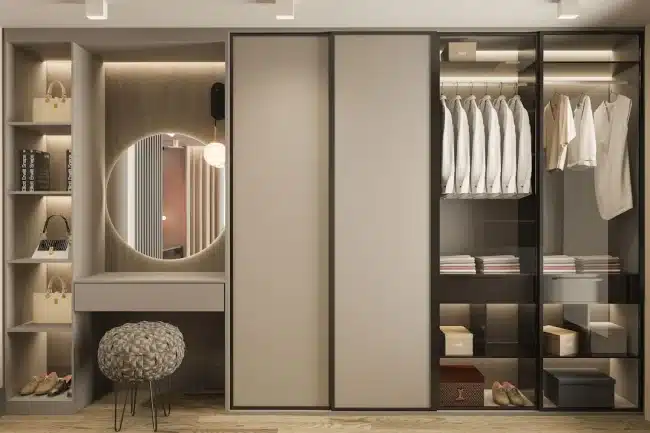
The basis of a shared closet design is the acknowledgement that both partners have different needs. The division into his and hers will make sure that everything is tidy, whereas common areas in the center will foster cohesion. This is the combination of individuality and common functionality which is the secret of stress-free everyday life.
Dividing the Closet Layout for Individual Preferences
Begin by evaluating the clothing and accessory requirements of both of the users–do they need additional hanging space, drawers, or shelves? Then split up the closet in that way, with tall partitions or even visual demarcation such as contrasting finishes to mark zones.
One side can be fitted with custom options such as a jewelry drawer, whereas the other will be optimized towards hanging clothes such as shirts and slacks. Assigning each individual his or her own section will reduce friction and make the layout feel personal and considered.
Shared Central Storage Zones for Accessories or Laundry
Although separation is significant, a central place to have common objects makes the space functional. Such mid zone may comprise an integrated laundry basket, common hamper, or accessory drawers of scarves, hats, or lint rollers.
Or you may include open shelves or a common valet tray to keep everyday items such as wallets, watches, or keys. Such a common center creates convenience and prevents overlapping of the individual zones.
Maximizing Vertical Space for Dual Users
In a one-closet household, every inch is valuable, and that includes inches on the vertical axis. You can get twice as much storage space without taking up any more space by using the full height of the closet.
Double Hanging Rods for Shirts, Jackets, and Pants
The double hanging rods provide twice the hanging space in a single section hence very useful with shirts, blouses, and slacks. Put rods at different heights so that shorter garments can fit and longer ones can as well. This arrangement is ideal in every single zone, organizing things clean, available, and apart. In the case of couples having similar wardrobes, mirrored layouts on both sides are made to balance and to make it symmetrical.
High Shelves for Seasonal or Rarely Used Items
The upper shelves are the best place to keep things you do not use daily such as seasonal clothes, travel luggage or souvenirs. Labeled storage bins or transparent containers will help to have everything organized and visible.
To have some extra luxury, think of pull-down shelves systems that will allow reaching the higher items without having to use the step stool. These additions enable the vertical space to be used by both partners. Get an instant quote now!
Tailored Storage Features for Each Person
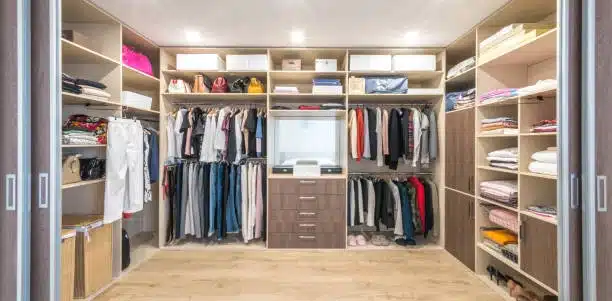
Custom closets shine when they’re built around the individual. Whether it’s jewelry, belts, ties, or sweaters, integrating personalized features creates a closet that caters to your exact needs—and makes daily routines more efficient.
Jewelry Drawers, Tie Racks, and Belt Organizers
Delicate jewelry is stored in velvet-lined jewelry drawers, which protect them and make them look pretty. Tie and belt racks are built-in, so that in his case, accessories are wrinkle-free and ready to be picked up.
These specialty additions can be added to the respective section of each user so that everything is easy to reach and the closet will be clean and appealing to the eye. This comes out as a boutique like experience tailored to its individual.
Deep Drawers for Folded Items and Private Storage
There is no need to have everything out in the open. Deep drawers provide a discrete place to store undergarments, folded sweaters or personal mementoes. Putting every individual drawer makes things easier and helps in laundry activities.
You may also want to alternate the way the drawers are arranged between the various partners, based on their wardrobe habits, dividers for socks, tall drawers for jeans, shallow trays for watches.
Style Meets Function in Shared Closets
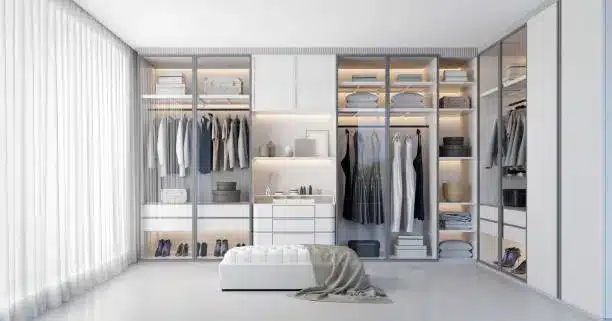
In a daily used space, form is as important as the functional part of it. Shared closets are to be designed in a harmonious style and at the same time be able to create a slight personal touch. Finishes, lighting and layout that respects both of you will make a beautiful functional space.
Coordinated Finishes with Personal Accents
Use an overall color scheme that unifies the closet system- soft neutrals, rich woods or bright whites. Then add personal touches such as drawer pulls, cabinet handle or decorative boxes in each person style. As an example, one of the partners may choose the gold hardware and the other one will choose matte black-just make sure they are matched to make the overall design to be balanced.
Balanced Lighting Across Both Sections
Both visibility and atmosphere require good lighting. Place LED strips on shelves, drawer motion-sensor lights, and overhead task lighting to better light up the space. Ensure that the lights are well distributed between the two zones so that each side does not feel like an afterthought. Even dimmers or smart lighting modes can be used to create an ambiance per user. Make an appointment with us now!
Avoiding Clutter and Conflict
The biggest enemy of shared storage is clutter. With two users, it’s easier for closets to become chaotic—unless you put systems in place that make organization simple and sustainable.
Built-In Laundry Bins to Eliminate Overflow
Nothing ruins a beautiful closet faster than a pile of dirty laundry. Built-in laundry closets, hampers or tilt-out bins keep clothing out of sight and under control. Each user can have their own bin to reduce confusion and streamline laundry days. This approach eliminates overflow and encourages tidiness without effort.
Labeled Drawers and Baskets for Easy Identification
It is not only pantries that need labels, shared closets also respond to them. Have labeled baskets of shoes, hats or accessories and label the inside of drawers to remind the user what goes where. This will avoid migration of items across zones and guesswork. It is particularly useful in walk-in closets of bigger size where certain items can be shared among the partners.
Enhancing Daily Routines Through Customization
Custom closets don’t just store things—they support your lifestyle. With smart layouts and personalized features, your shared closet can enhance both morning and evening routines, making the start and end of each day smoother for both users.
Morning and Evening Zones for Better Organization
Design separate zones for morning routines (with quick-grab essentials, workwear, accessories) and evening routines (pajamas, skincare, lounge clothes). This structure helps minimize stress during transitions. You can also incorporate hooks, charging shelves, or even a valet rod to streamline outfit planning. These details support a calm, consistent rhythm for both partners.
Mirrors, Seating, and Charging Stations for Convenience
A common closet must be a place you would want to use not just transit through. Put up a full length mirror, small bench or cushioned seat to dress comfortably. Install charging points in drawers or shelves so that the devices are ready and in order. Such considerations make your closet a practical dressing room designed to fit contemporary practices.
As we serve Washington D.C., Maryland, Virginia and West Virginia, you can find our showrooms in the following locations:
Frequently Asked Questions (FAQs)
How can I split a walk-in closet for two users?
Start with separating the space into two different areas according to the needs of each individual. Copy or supplement each other in terms of layout with shelving, drawers, hanging rods. Add a common meeting area of laundry or accessories. This maintains the closet practical and respects the habits of each of the partners.
What features should I include in a his and hers closet?
Important elements are two hanging rods, deep drawers and accessory storage such as jewelry trays, tie racks or belt hooks. Have high shelves to accommodate seasonal goods and hampers inbuilt to store laundry. Individual areas and even lighting improve the comfort and usability.
Can I make a shared closet feel personalized?
Yes! Consider the personality of each user by using subtle design variations such as hardware, interior of drawers or decoration accessories. The uniqueness of each partner is guaranteed by the separated zones with individual layouts so that they could feel that this is their own space yet still have a unified design.
How do I prevent clutter in a dual-user closet?
Avoid clutter by having built-in laundry bins, labeled storage containers and zoning. Make sure every user has some space to store his/her items. Incorporating storage such as pull-out shelves or secret compartments can also eliminate clutter that is visible to the eye and keep everything clean.
What layout works best for couples with different storage needs?
An adjustable structure where the parts can be changed is the most appropriate one- adjustable shelves, modular drawers, and vertical storage. Begin by knowing the most needed by each individual (e.g. hanging space vs. drawers) and assign them. Make sure there is a common area where everyone can place their daily things to promote togetherness rather than competition.