

Built-in media center design has quietly become one of the most requested upgrades in DMV living rooms, and once you notice why, it is hard to unsee it.
Every living room has a wall that gets the most attention, whether it was designed for that role or not. In most homes, that wall is the one with the television — and in most homes, that same wall is also where the visual clutter of daily life quietly piles up. A tangle of cables behind the stand. A gaming console balanced on top of a soundbar. Remotes that live in the couch cushions because there was never a real place for them. None of it is a crisis. But every time someone sits down to watch something, or guests walk in for the first time, that wall is making an impression — and it is rarely the impression the rest of the home is making.
This is exactly the problem built-in media center design solves at the root. Instead of another piece of furniture sitting in front of the wall, the wall itself becomes the design. At Closet & Beyond, we build custom entertainment walls for homeowners across Virginia, Maryland, and Washington D.C. that give the busiest wall in the house the same level of intention as everything else in the room. Here are the ideas that consistently make the biggest difference.
Floor-to-Ceiling Cabinetry That Frames the TV
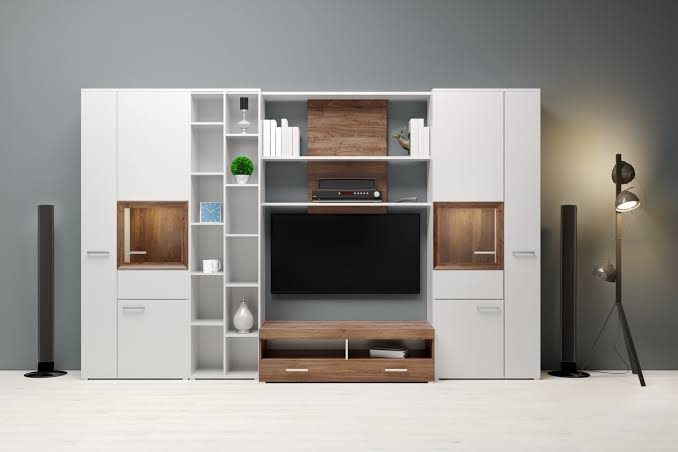
The single biggest shift in built-in media center design over the past several years has been the move away from a stand-alone console and toward full-wall cabinetry that frames the television on every side.
Rather than a piece of furniture the TV sits on top of, the television becomes one element inside a larger architectural composition — flanked by closed cabinets for equipment, open shelving for books and objects, and a scale that matches the proportions of the room instead of just the size of the screen. The effect is immediate. The wall stops reading as “the TV setup” and starts reading as part of the house.
Hidden Cable and Equipment Management
Cables are the most persistent visual problem in any entertainment area, and they are also the one that a proper built-in media center design solves completely rather than partially.
Custom cabinetry routes every cable internally — through the structure of the unit itself — so nothing is visible from the front of the room. Streaming devices, gaming consoles, and routers get their own ventilated, concealed compartment instead of sitting out in the open collecting dust and remotes. Once the equipment has a real home, the rest of the room simply looks calmer, even without anything else changing.
Open Shelving for Display, Not Just Storage
One detail that separates a good built-in media center design from a great one is what happens on either side of the television, not just behind it.
Open shelving sections give a household somewhere to put the things that actually make a room feel like theirs — books, framed photos, travel finds, a few carefully chosen objects. When those items sit inside a designed cabinetry system instead of scattered across random surfaces, they read as curated rather than accumulated. The shelving becomes part of the room’s personality, and the television becomes just one part of a much richer wall.
Warm Materials Over Cold, Glossy Finishes
The high-gloss white and black finishes that dominated entertainment center design a decade ago are giving way to something warmer. Rift-sawn white oak, walnut veneer, and matte painted finishes are the materials showing up most often in current built-in media center design — and for good reason. They photograph beautifully, but more importantly, they make the room feel calmer to actually live in. A media wall finished in warm wood tones reads as furniture the family will keep for years, not a trend piece that will look dated in five.
Fireplace Integration for a True Focal Point
One of the strongest requests we receive across McLean, Great Falls, and Potomac living rooms is a fireplace built directly into the media wall. Combining the television and the fireplace within a single cabinetry system creates a focal point that does double duty — warmth and entertainment in one architectural gesture, rather than two competing elements fighting for the same wall.
This is not a small detail. Interior designers consistently point to a room’s focal point as the single strongest driver of whether a space feels organized or chaotic. According to research summarized by the Rocky Mountain College of Art and Design, visual clutter overloads the brain’s capacity to process a space, while a room with a clear, well-composed focal point supports calm and reduces the kind of chaos our brains register as stress.¹ A fireplace-integrated media wall gives the room exactly that anchor, and it is one of the clearest examples of what strong built-in media center design can accomplish in a single wall.
Lighting That Changes the Whole Mood of the Room
Integrated LED lighting inside the cabinetry — beneath shelves, behind glass panels, along the base of the unit — does more work than most homeowners expect going into a project. Warm white lighting in the 2700K to 3000K range gives the wall a soft glow in the evening that overhead lighting alone cannot replicate. It is a small addition with an outsized effect on how the whole living room feels once the sun goes down.
Built-In Media Center Design Across the DMV
Every home we work with brings a different set of constraints and a different sense of scale. In larger living rooms across Great Falls and Potomac, media walls often stretch twelve feet or more, with room for a fireplace, full display shelving, and a genuinely architectural presence. In more compact living rooms throughout Arlington and Alexandria, the same principles apply on a smaller footprint — floor-to-ceiling cabinetry that uses height rather than width to create the same sense of intention. In Bethesda and McLean, we frequently design media walls that need to handle heavy daily use from a full household without ever looking cluttered.
Whatever the size of the room, the starting point is the same: understanding how the space is actually used before a single cabinet is drawn.
Explore our media center solutions →
See our full range of custom storage solutions →
Frequently Asked Questions
What makes built-in media center design different from a regular TV stand?
A TV stand is furniture sitting in front of a wall. Built-in media center design treats the wall itself as the design — cabinetry is built into the architecture of the room, cables are routed internally, and the television becomes one element within a larger composed space rather than the entire focus.
Can this work in a smaller living room?
Yes, and it often makes a bigger difference in a smaller room than a large one. Floor-to-ceiling cabinetry uses vertical space that a freestanding console never touches, which makes a compact wall feel considered rather than cramped.
Is a fireplace required for a built-in media wall to feel complete?
Not at all. A fireplace is one of the most requested additions, but a well-designed media wall with cabinetry, shelving, and proper lighting creates a strong focal point on its own.
How long does a project like this typically take?
Most projects move from a free design consultation to a same-day 3D rendering and cost estimate, with installation completed within about three weeks and usually finished in a single day.
A Living Room That Finally Feels Finished
The wall that holds the television carries more visual weight than almost any other wall in the house, simply because of how often it gets looked at. Built-in media center design gives that wall the same intention the rest of a well-designed home already has — cables disappear, equipment finds a proper home, and the room stops apologizing for itself.
Book your free design consultation today →
Call us at (703) 810-3821 — we offer in-home, virtual, and showroom consultations throughout Virginia, Maryland, and Washington D.C.